New Puppy Training Starter Guide: 4-Week Routine, House-Training, First Commands, and Socialization
A new puppy learns fastest when daily life is predictable, rewards are consistent, and expectations match the puppy’s age. The goal for the first month isn’t perfection—it’s building repeatable habits: a simple daily rhythm, fewer accidents, easy “starter” cues, and calm social experiences that create confidence without overwhelm.
Before Training Starts: Set Up the Home for Success
Training goes smoother when the environment does half the work. Start by deciding how you’ll prevent unsupervised wandering and accidents.
- Choose a confinement plan: a crate plus a puppy-proofed pen, or a small gated room. Use this space to rehearse calm behavior and protect your home while your puppy learns.
- Stock the basics: tiny, soft, high-value treats; a clicker (optional); safe chew toys; and an enzymatic cleaner for accidents.
- Pick one potty spot outdoors: keep the route short and boring so your puppy stays focused on the job.
- Align on household rules early: furniture access, feeding times, which door is the “potty door,” and the exact cue words (“outside,” “leave it,” “off”). Consistency prevents confusion.
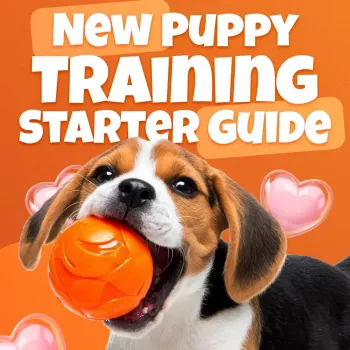
If you want a ready-to-print plan that keeps everyone consistent, use the New Puppy Training Starter Guide (printable 4-week plan). For comfort in a crate or pen during warmer days (especially in smaller rooms), a portable rechargeable fan with LED light can help you maintain a calm, cool setup during naps and quiet time.
A Simple Daily Routine for an 8-Week-Old Puppy
Think in repeating cycles, not a strict schedule. Most young puppies do best with: potty → play/training → water/food (as scheduled) → potty → nap. Frequent sleep keeps your puppy regulated and reduces the “overtired” behaviors that look like hyperactivity or extra nipping.
- Keep sessions tiny: 1–3 minutes, several times a day. Stop while your puppy still wants more.
- Plan decompression: after visitors, car rides, or a new experience, guide your puppy into a chew-and-nap reset.
- Practice alone time early: short, positive separations (seconds to minutes) help prevent future separation stress.
Sample day plan (adjust to your puppy’s meals and energy)
| Time block |
What to do |
Goal |
Notes |
| Wake-up |
Potty trip, then a short sniff walk |
Start the day accident-free |
Carry to the potty spot if needed; reward immediately after finishing |
| Morning |
Breakfast + 2–3 minutes of training |
Motivation and focus |
Hand-feed part of the meal for training reps |
| After eating |
Potty trip, then chew toy in crate/pen |
Prevent post-meal accidents |
Most puppies need to go shortly after meals |
| Midday |
Play + gentle handling + potty |
Bonding and body comfort |
Touch paws/ears briefly; reward calm acceptance |
| Afternoon |
Nap, then short socialization exposure |
Confidence building |
Keep exposures low-intensity and positive |
| Evening |
Dinner, potty, calm play, settle practice |
Wind-down skills |
Practice “place” or calm mat time |
| Before bed |
Final potty trip, crate/pen bedtime |
Overnight success |
Keep bedtime consistent; avoid late-night rough play |
House-Training: The Fastest Way to Build Reliable Habits
Potty training starts the moment your puppy arrives. Every accident indoors strengthens the wrong habit, so your main job is prevention plus quick, clear rewards for the right choice.
- Use a tight supervision loop: tether your puppy to you, or use a pen/crate when you can’t watch closely.
- Reward timing matters: give the treat within 1–2 seconds after your puppy finishes outside to make the connection crystal clear.
- Know the common triggers: after waking, after eating/drinking, after play, and after exciting moments.
- Handle accidents correctly: interrupt gently (no scolding), go straight outside, then clean with enzymatic cleaner to remove odor cues.
For additional house-training details and troubleshooting, the Humane Society’s guidance is a helpful reference: House Training a Puppy.
First Commands That Make Daily Life Easier
Early training works best when it prevents common problems: ignoring you, grabbing unsafe objects, and turning excitement into jumping or nipping. Prioritize these skills:
- Name response: say the name once → when the puppy looks, mark (“yes”) and treat.
- Touch (hand target): puppy bumps your hand → mark and treat. Great for redirects and recalls later.
- Sit and down: simple positions that help your puppy pause and think.
- Come (indoors first): make it a game—short distance, happy voice, fast reward.
- Leave it and drop it: safety cues that reduce resource guarding risks and “puppy vacuum” moments.
Teach one cue at a time: lure the movement, mark, reward, then add the cue once your puppy starts predicting what’s coming. Avoid repeating cues; if your puppy doesn’t respond, make it easier—get closer, use a better treat, or reduce distractions. For more training basics and age-appropriate expectations, see: American Kennel Club: Puppy Training Basics.
Socialization Done Safely: Confidence Without Overwhelm
The American Veterinary Society of Animal Behavior explains why early, careful socialization is so important: AVSAB Position Statement on Puppy Socialization.
Week-by-Week Plan (4 Weeks) to Build Momentum
Week 1: Routine and prevention
Week 2: Add simple cues
Week 3: Build reliability
Week 4: Real-life skills
Printable Support: Checklists, Trackers, and an At-Home Plan
For a ready-to-use printable plan with step-by-step routines, house-training guidance, beginner commands, and socialization prompts, use the New Puppy Training Starter Guide.
FAQ
What’s a good routine for an 8 week old puppy?
A reliable routine uses repeating cycles: potty right after waking, then a short play/training session, meals on schedule, another potty trip, and a nap. Plan frequent potty breaks after sleep, eating/drinking, and play, and keep training sessions to 1–3 minutes so your puppy stays engaged.
When do you start training a puppy to potty
Start on day one as soon as your puppy comes home. Use close supervision or a crate/pen when you can’t watch, take your puppy out on common triggers (waking, eating, play), and reward immediately after they finish outside to build the habit fast.
Recommended for you








Leave a comment