Sentimental Space, Saved: A Simple Checklist for Letting Go Without Losing the Memories
Sentimental items can quietly take over shelves, closets, and corners—not because they’re useless, but because they feel irreplaceable. The goal isn’t to “get rid of your past.” It’s to keep the meaning while reducing the volume, so the things you love don’t disappear into stacks and bins. The process below uses gentle boundaries and a repeatable checklist approach to keep decisions consistent, calm, and emotionally manageable.
Why sentimental clutter is harder than regular clutter
Sentimental objects tend to carry identity, relationships, milestones, and grief—so the decision feels higher-stakes than “keep or toss.” Guilt often shows up as, “If I donate this, I’m disrespecting the person or moment,” even when the memory is secure without the object. When every item feels unique, decision fatigue ramps up fast; a repeatable checklist reduces the emotional load. And because space is finite, keeping everything usually means the most meaningful pieces get buried, not honored.
If stress has been building around clutter, it can help to remember that chronic stress affects the body as well as the mind (see the American Psychological Association’s overview).
A gentle reset before you start: set boundaries that protect your energy
Start smaller than you think you need. Choose a time cap (20–45 minutes) and a stopping point (one box, one drawer, one shelf). Then set up a simple “landing zone” with five labels: Keep, Memory Box, Donate, Recycle/Trash, Digitize.
Avoid mixing categories in the same session—photos plus kids’ art plus inherited décor is a fast track to overload. Pick one type at a time. If grief or trauma is involved, plan support: schedule breaks, invite a trusted friend to sit nearby, or pause when emotions spike. If you want professional organizing frameworks and support, the National Association of Productivity & Organizing Professionals (NAPO) is a solid starting point.
The decision framework: keep fewer items, keep the meaning
Begin with purpose: is the object for use, display, or memory? If it’s only for memory, it competes with other memory-items for limited space. Next, look for redundancy. Keep the best representative, not every version (one concert tee, not ten). Separate the memory from the material when you can—a photo and a short note can preserve meaning with near-zero space.
When choosing what stays, prioritize items that are specific and story-rich over vague or guilt-based keepsakes. Finally, use a “container rule”: the box or shelf is the limit, not the category. If the container is full, something must be swapped out—no expanding the boundary in the moment.
Quick decision table for sentimental items (use with the checklist)
| Item type |
Keep when… |
Downsize when… |
Small-space alternative |
| Cards/letters |
It includes a personal message you’d want to reread |
It’s mostly signatures, repeats, or generic wording |
Photograph/scan the best lines; keep 5–15 favorites |
| Kids’ art/schoolwork |
It captures a milestone or a truly unique piece |
There are stacks of similar drawings/worksheets |
Take photos; keep 1 portfolio folder per child/year |
| Inherited objects |
You actively display/use it and it fits your home |
It’s stored “just because” and causes stress |
Keep one meaningful piece; document the story in writing |
| Travel souvenirs |
It’s functional (mug, scarf) or deeply tied to a moment |
It’s small-but-many and never used |
Create a framed collage or photo album page |
| Clothing with memories |
You still wear it or it symbolizes a key life chapter |
It doesn’t fit, is damaged, or lives in a bin |
Photo it; turn one item into a quilt/pillow; keep a small swatch |
| Photos |
They’re irreplaceable and not backed up |
There are duplicates/blurry shots |
Digitize and back up; keep a curated physical album |
How to use the “Sentimental Space Saver” checklist (a step-by-step session)
Step 1: Choose one micro-category
Pick something narrow: “birthday cards from 2010–2015” is manageable; “all paper memorabilia” is not. A smaller scope makes it easier to finish, which builds trust in the process.
Step 2: Do a fast first pass
Remove obvious trash, duplicates, and damaged items before making emotional calls. This reduces the pile without asking your nervous system to decide everything at once.
Step 3: Use consistent prompts per item
Step 4: Apply the container limit
Step 5: Write a quick “memory note” for donated items
Step 6: Close the loop
Digitize without creating new digital clutter
For irreplaceables like family photos and letters, use at least two backups (cloud plus an external drive). Add context with a short caption (“Grandma’s note after graduation, 2009”) so the digital version retains meaning. The Library of Congress personal archiving guidance is a helpful reference for preserving and organizing personal materials.
Keeping what matters visible (so the clutter doesn’t return)
Common sticking points and kinder re-frames
Tools to make sentimental decluttering easier
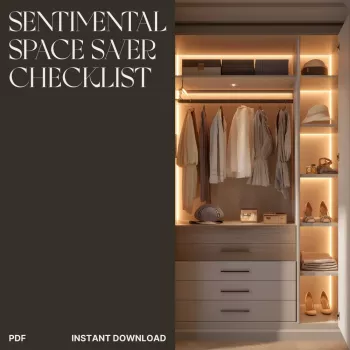
If you want a structured process you can repeat without rethinking every decision, use a printable guide: Your “Sentimental Space Saver” Checklist | Digital Decluttering Guide for When Sentimental Items Block Space | Minimalist Home Organization Printable.
For a comfortable sorting station (especially if you’re spreading items out by category), a dedicated surface helps keep “in progress” from drifting across the house: 63″ Farmhouse Dining Table for 4-6, Wooden Rectangular Table with Geometric Base.
And if you tend to avoid the work because it feels physically draining, a comfort boost can make it easier to start and finish a session: Portable Rechargeable Fan with LED Light – Battery Operated for Home & Travel.
FAQ
What sentimental items to keep
Keep the few items that are story-rich, specific, and either useful, display-worthy, or uniquely tied to a milestone. Choose the “best representative” of a memory and let a container limit (like one memory box per person or life chapter) set the boundary.
Recommended for you









Leave a comment